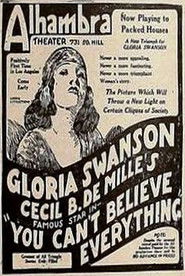
While on vacation in New York, millionaire cattle rancher John Keyes falls in love with musical comedy star Fritzi Carlyle. Recognizing the opportunity for a great story, Fritzi's press agent encourages her to accept the Westerner's proposal of marriage, only to deny it the next day in a wave of newspaper publicity. Disheartened, Keyes returns to Arizona and Fritzi continues performing until she suffers a nervous breakdown. Reading of Fritzi's misfortune, Keyes returns East, kidnaps Fritzi and takes her to Arizona. There, the change of climate performs wonders and she recovers quickly. Meanwhile, her stage manager sends detectives after her, and when they arrive in Arizona ready to arrest Keyes for kidnapping, Fritzi explains that the whole adventure was an elaborate publicity stunt and announces that she and her Arizona cowboy are going to be married.

Pat Dugan puts his last penny into oil prospecting and finds the oil. He deserts the old shack for his idea of what a palace should be and sends Jimmie to college. Jimmie promptly thrashes three of the students and polishes off the policeman who interferes. Then he leaves college for a partnership in a nursery business with a young Italian. Pat moves east and settles next door to Lady Blessington, but supposes the placid old lady who fraternizes with his wife to be the house- keeper. Jimmy turns up and falls in love with Joyce, Lady Blessington's god-daughter and marries her in spite of his father's commands, but when Pat sees how it all comes out he takes the full credit to himself.
A secretary (Gloria Swanson) uses her boss to get money for her unfortunate sister (Ann Kroman) but eventually falls in love with him.

The Earl of Selkirk and his family learn of the impending arrival of American pirate John Paul Jones, they flee their castle, leaving behind Nora, the kitchen maid. Left alone in the house, Nora dons the clothes of her mistress and parades herself about the castle until the arrival of the king's light infantry. Because they mistake her for the lady of the house, she invites them to be her guests.

James Ashe sends his son James Jr. off to manage a family-owned logging mill. While attending to his duties, James Jr. falls in love with a beautiful girl.

The story of a poor young woman, separated by prejudice from her husband and baby, is interwoven with tales of intolerance from throughout history.

Disgusted when the police department fails to apprehend the murderer of her guardian, Henri Du Bois, Celeste decides to track down the criminal herself. Her only clue is a cuff link dropped near the scene of the crime on which a sphinx is engraved, and with it, she wanders through Paris' tough Moulin Noir district. When she notices a young man wearing a tie pin of identical design, she cultivates his acquaintance and eventually asks him to visit her in her home. His suspicious behavior there convinces Celeste that he is the guilty party, and although she has fallen in love with him, she has him arrested, whereupon she learns that he is Du Bois' missing son, Andre. Further detective work reveals that the real murderer is Celeste's rejected suitor, Raoul Laverne. Upon his confession, Andre is released and eventually marries Celeste.

Hard-working insurance company bookkeeper John Carter, comes home Easter eve to his suburban cottage with a potted lily for his loving wife and two daughters. The Carters live happily until cashier Charles Ryder is murdered by the night watchman, a "coke sniffer" in need of money, and Carter is accused because he worked with Ryder that evening.

When playwright Curtis de Forest Ralston becomes enamored of actress Viola Strathmore, who is to appear in his play Vanity, Viola induces him to change certain parts and give her more lines. Curtis, who is not as talented as he believes himself to be, fails at his job but is saved by his wife Anita, a former actress, who has forsaken her career for marriage. Anita and her old manager, Bruce Winthrope, fashion the play to suit Viola, and Vanity becomes a huge success. The play's triumph enlarges Curtis's ego even further, and he deserts Anita for Viola.

Jennie is a slavey in a theatrical boarding house. To her the actors are all wonderful, but Montague Booth is the chief. In an accident Booth is disfigured for life and is saved from suicide by Jennie. They join a medicine show in which Booth is lecturer, but Jennie cannot stand the road. Booth leaves the show and takes up a homestead claim. The manager of the show sends one of Booth's old loves to get him back, for his services are valuable, but Belle fails after very nearly wrecking everyone's happiness.

Social worker John Warfield meets socialist radical Guido Garcia, and together they establish a refuge in San Francisco for life's unfortunates.

Lola Montrose ignores the scorn of society to live with Dr. John Hampton, the man she loves. After tiring of his mistress, Hampton tells Lola that he is planning to marry a "good woman" who will exert the proper influence over his son Irwin. Begging Hampton to marry her, Lola confesses that she too has a son, who is being reared in a religious institution for homeless children, but Hampton insists that he must not darken his son's future. Thirsting for revenge, Lola determines to marry Irwin. After inebriating the youth, Lola takes Irwin to the minister, who refuses to perform the ceremony. Too drunk to realize that there has been no wedding, Irwin takes Lola home and introduces her as his wife.

A saloon owner loans her lover the money to buy a house, which he has led her to believe they will live in after they're married. Instead, he takes the money and buys a saloon in another town.

Melia Nobbs, a young Canadian woman, supports both her invalid father Ambrose and brother Henry. When Henry faces arrest for helping himself to his employer's cash, Melia steals the amount from the star of the theater where she has been dancing and offers it to her brother if he will enlist in the army. Henry agrees and goes off to war, making Ambrose proud of his son, but when Ambrose learns that his daughter has been arrested for theft, he disowns her. Melia does not reveal the reason for taking the money and is sent to prison. Meanwhile, Henry fights bravely in France and returns home minus an arm but wearing the Victoria Cross. He finds his sister, weak and worn from overwork, in the prison hospital. Seeing her brother with his medals, Melia realizes that her sacrifices for him and her country have not been in vain, and that in her own way, she has served her country.


A 1917 film directed by Clifford Smith.

Half-breed Joe Elk wavers between the "civilized" nature of his white father and the passion of his Indian mother. He falls in love with Alice McRae, but Alice is in love with Bruce Smithson, who is an officer at the Hudson Bay Trading Company.
Failing to get a loan from Nicholas Eyre, the Steel King and friend of his wife's father, Robert Lathrop induces his wife to beg for the money he plans to spend upon his mistress. He is given a check. Hurrying to Lola's apartments, he finds her in the arms of her lover, Haskell. In the fight that follows, Lathrop is killed and left in the park. Believing her husband to be a suicide because Eyre refused to advance him funds, the wife plans to revenge what she considers his murder, but enlightenment comes after terrible damage has been done.

The setting is the Old West town of Paradise, Nevada, where a young woman, Mercedes Murphy (played by Louise Glaum), co-owns and operates a combination saloon and dance hall called the Red Hen with her business partner, Slick Barney (played by Jack Richardson). Her little half-sister, Olive "Live" Sumner (played by Mildred Harris), who is crippled, lives with her and she makes every effort to protect the child. A tough, but good-hearted businesswoman, Mercedes shows a tender side at home with Live. Her partner, Slick, and a cowboy called the Heller (played by John Gilbert), who has a heart of gold, are both interested in Live.