A cameraman wanders around with a camera slung over his shoulder, documenting urban life with dazzling inventiveness.

A soldier returns to Kyiv after surviving a train crash and encounters clashes between nationalists and collectivists. The story of the suppression of the Bolshevik uprising at the Arsenal factory in Kyiv by the Central Council troops.

The momentous film stars Mykola Nademskyi as the grandfather of Tymish, whom he alerts to the secret treasure buried in the mountains of Zvenygora – a treasure that rightfully belongs to his homeland. The film wonderfully blends both lyricism and politics and uses its central construct to build a montage praising Ukrainian industrialization, attacking the bourgeoisie, celebrating the beauty of the Ukrainian steppe and retelling ancient folklore. Sergei Eisenstein said of the film, "As the lights went on, we felt that we had just witnessed a memorable event in the development of the cinema".

The film tells about the creation of the first collective farm communes and class enmity. Vasyl, a member of the Komsomol, with the help of a local party organization, gets a tractor and plows private boundaries "on kulak fields." However, this enthusiasm will cost him dearly.

Set in an imaginary land where the threat of revolution spurs the Emperor to seek exile in one of the most distant parts of his realm. There he meets Elka, the daughter of a revolutionary who has been banished here due to his confrontational activities. The two fall in love but meet a violent end when the revolutionaries, led by Elka's father, destroy the palace.

The defeated remnants of vile Ukrainian nationalists, headed by the leader of the Ukrainian liberation movement, Symon Petliura, cannot accept their historical fate and are plotting an insurrection against the Soviet regime in Ukraine. There is nothing Petliura and his cohorts would not do to win back control over Ukraine, including selling it to the highest bidder, in this case, the Polish dictator Jozef Pilsudski. A group of plotters are coordinating an insurrection in Kyiv with an attack from Poland headed by Petliura’s general Yurko Tiutiunnyk. Predictably, the invincible Red Army defeats the nationalist plotters and proves that the Soviet borders are impregnable.

The Government of the fictional country Norland has unleashed a war with the neighboring Galikania and is suffering one defeat after another. A group of conspirators who were dissatisfied with this state of affairs, led by the Social Democrat Frank Frey arrange a coup to overthrew the emperor of Norland. But the working class does not like the new order either. Workers expose Frank Frey's policy of continuing the war and a revolution breaks out in the country. The leader of the socialist revolution becomes a mechanic of the name Franz Stark.

The film is based on V. Yurezanskyi’s novel The Missing Village about the struggle of Ukrainian Cossacks for their freedom during the reign of Catherine II. Free Cossacks from the village of Turbai in Poltava region, who were included in registers of Myrhorod Pact, suddenly find out that at the order of Catherine II they become the property of the Ukrainian landlord, pan Bazylevskyi. He treats Cossacks like his usual serfs. Cossacks ask the empress for help, but receive no reply. Then, they rebel and set Bazylevskyi’s estate on fire. The owner and his family die during the fire. The vengeance of the Russian empress is terrible, as dozens of Cossacks are beaten to death, and the village of Turbai is doomed to destruction. The film is lost.

The film is dedicated to the achievements of the Ukrainian SSR for the eleventh anniversary of the October Revolution.

An audiovisual symphony that delves into the industrial, agrarian, and cultural fabric of the Donbas region during the inaugural Soviet Five Year Plan. It spotlights anti-religious campaigns, propagandistic marches, and the vibrant athletic culture of its time

An ideologically committed Red Army soldier returns home from the war and takes up a new struggle with the aim of collectivizing the land of a wealthy peasant.

The poor tailor Perchyk who dreams to buy a she-goat lives in a small town. Meanwhile, Perchyk’s daughter Frida falls in love with the unemployed Elia. Perchyk is totally against their marriage, as he cannot buy a she-goat if the son-in-law does not have any money. Finally, Perchyk buys a she-goat from a rich tavern owner but he gives him… a goat. Moreover, a police officer dissatisfied with the tailored uniform forges a document, according to which Perchyk and his whole family are expelled from the town as troublemakers.

Jimmy Higgings is a worker of the plant making weapons for the Tsarist Russia and the German Empire. During World War I, Jimmy speaks at a spontaneous rally against the war. He is arrested. When released, he becomes unemployed. He is happy to hear the news about the revolution; he volunteers into the American expeditionary force thinking that having the weapons he can fight against Germans – the enemies of the Russian revolution. However, finding himself in Russia, Jimmy soon realises that the expeditionary force of American volunteers fights not against the Germans, but against the young Socialist Russia. Without any hesitations, he takes the path of revolutionary struggle, he spreads propaganda among the American soldiers and distributes Bolshevik leaflets. Captured by the American military police, Jimmy Higgings does not betray his friends. He is sentenced to twenty years in a military prison. Jimmy cannot stand it and loses his mind…

Directed by Grigori Gritscher-Tscherikower.

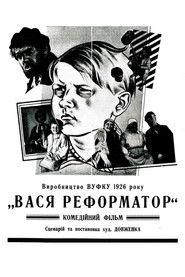
Lost film directed by Oleksandr Dovzhenko (his first film) and Favst Lopatynskyi. It is a satire of the NEP period. Vasia, the son of a factory’s worker, is attracted by the romance of adventures. And he goes to look for them. He saves a drowning drunkard who tries to beat him. Vasia escapes from him in a vehicle parked on the shore. However, the vehicle belongs to a superintendent who, when he does not find it, stages its theft. Meanwhile, Vasia exposes priests in the church. As a result, the church is turned into a cinema, and the priest becomes a cinema technician. And finally, Vasia’s last deed is catching a criminal at home and denouncing him to the militia.

Heroic war adventures of an orphan shepherd boy, who saved two Red Army scout soldiers from the pursuit by White Army and as a reward was admitted into the squadron.

Revolutionary melodrama based on Lev Nikulin's story "Хміль". 1917. The main character of the film - a "bourgeois intellectual" - does not sympathize with any side and avoids revolutionary events. However, as a result of a series of adventurous adventures, love intrigues and communication with the people, he goes over to the side of the proletariat.

Ukrainian Soviet film about the fate of a young Ukrainian peasant who became a participant in the revolutionary struggle.

This revolutionary epic likens the push for industrialization of Soviet Ukraine with the battle for Perekop during the Civil War. A missing plow blade is presented as a symbol of the country's backward peasant economy that needs to be transformed in the course of the industrial construction. In an onslaught of rapidly changing images, Ukrainian village with its peasants suspicious of everything new, dramatically collides with the frenzy of working factories, plants, and mines.

The heroine of the film leaves her husband, who does not allow her to study, takes her child with her and goes to medical school.